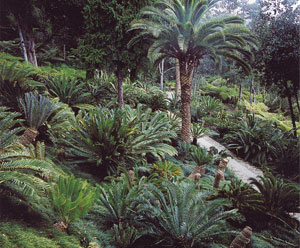
 One of the largest collections of cycads in the world, mainly originating from South Africa, is to be found in the Monte Palace Garden. These are often described as "living fossils", since they appeared in the Mesozoic Era, two hundred million years ago, and are related, in our imagination, with the extinct dinosaurs from the same period. One of their peculiarities is the way in which they have evolved, without changes in appearance, overcoming the great climatic changes and maintaining the characteristics of gymnosperms. They are plants with evergreen leaves, being unisex dioecious (The male and female flowers occur on different plants) and they have bare flowers (without perianths), with ovules not enclosed in an ovary, but arranged in carpels which insert themselves spirally onto an axis, forming a structure similar to a cone, except in the genus of the Cycas. One of the largest collections of cycads in the world, mainly originating from South Africa, is to be found in the Monte Palace Garden. These are often described as "living fossils", since they appeared in the Mesozoic Era, two hundred million years ago, and are related, in our imagination, with the extinct dinosaurs from the same period. One of their peculiarities is the way in which they have evolved, without changes in appearance, overcoming the great climatic changes and maintaining the characteristics of gymnosperms. They are plants with evergreen leaves, being unisex dioecious (The male and female flowers occur on different plants) and they have bare flowers (without perianths), with ovules not enclosed in an ovary, but arranged in carpels which insert themselves spirally onto an axis, forming a structure similar to a cone, except in the genus of the Cycas.
Cycads are often confused with palm trees since they both have a head of leaves, and the word "cycad" itself is derived from the Greek word "cykos" meaning "similar to the palm tree".
Its geographical distribution can be found in Japan, Madagascar, Mozambique, India, the Philippines, Thailand, Australia and New Guinea, amongst other locations.
During the Mesozoic Era, the splitting of one continent into seven began the geographical dispersion of the cycad and its adaptation to different climates. Despite needing a good deal of humidity and tropical heat, and thus confining themselves principally to the tropical and sub-tropical regions, there are some species that have adapted to regions which are more arid or which experience periods of intense cold during the winter. This fact is mostly due to the resistance of the stem and the leaves to intemperate weather, high temperatures and even fire. The stem, which is similar to cork, may be underground or may reach a height equal to or greater than 10 metres, and the leaves, although very dedicate when new, when they reach adult size (which can be three metres) become harder and resistant, resembling leather. Cycads grow about 2.5 centimetres annually, they may have between 4 and 50 leaves, which are renewed slowly, and they can last one, two or five years.
These plants are very popular as decorative plants, owing to their rarity, longevity and attractive leaves. Since they do not form growth rings on the stem, their age cannot be calculated by counting these, but by a combination of other factors such as, for example, counting the scars left by old leaves divided by the number of times that the plant renews its foliage and also by the number of leaves renewed each time. For this reason the age of the plant may only be obtained as an average figure.
Courtesy: Monte Palace - A Tropical Garden Book
Open daily from 9 a.m. to 6 p.m.
Caminho das Babosas #4 or Caminho do Monte #174 |


